Why Grief Support Groups Fail Men — And What Is Quietly Replacing Them

The Dead Dads Podcast
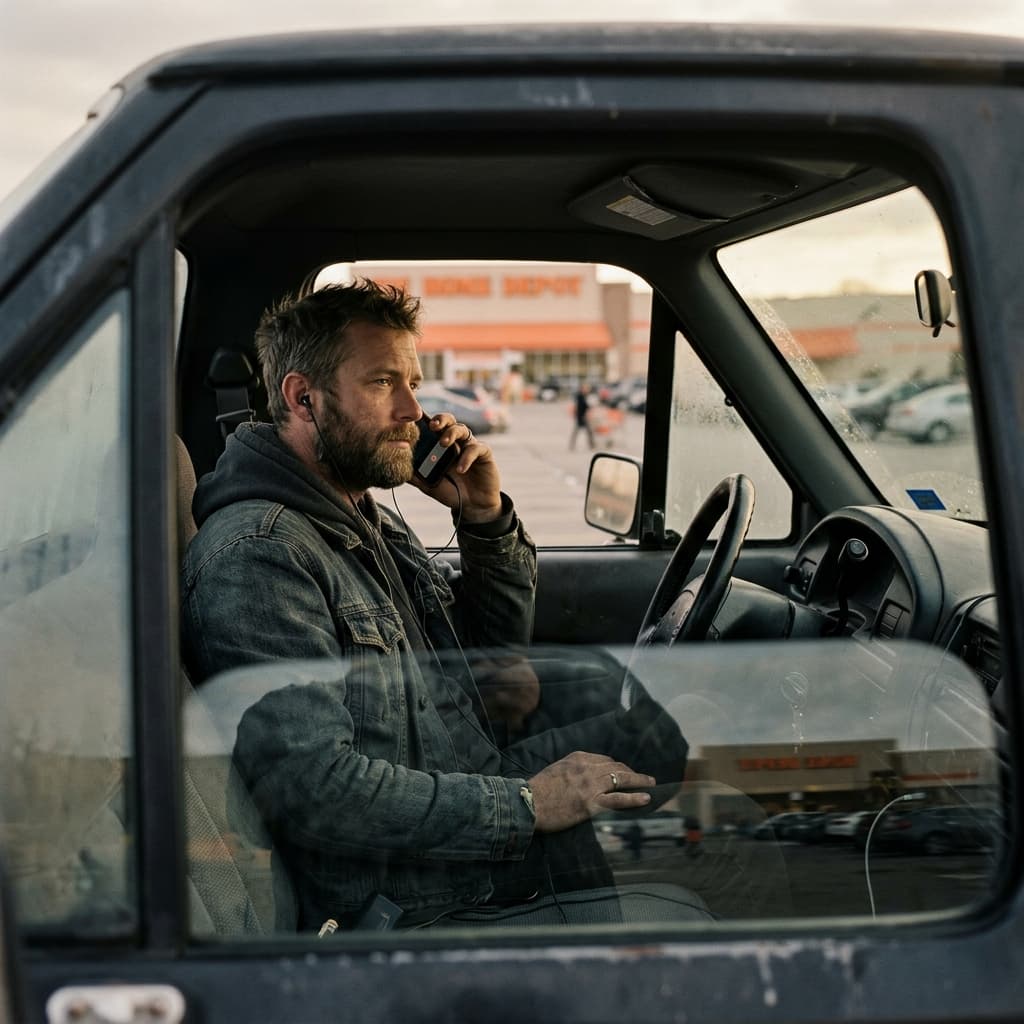
Nearly a quarter of men say they would never consider professional therapy for mental health struggles, even when they're in crisis. Not because they don't need help. Because the available formats don't fit how they operate.
Grief support is where that mismatch gets sharpest.
The circle of chairs. The facilitated check-in. "Would anyone like to share how they're feeling this week?" It's a Tuesday at 7pm and you're supposed to have your grief ready to go, formatted for group discussion, accessible on demand. For many men, that's not where the grief lives. It lives in the plumbing aisle at the hardware store, in the middle of a normal Wednesday, when you see the kind of elbow fitting your dad always kept in a coffee can in the garage. And then it's gone again. And Tuesday's a long way off.
This isn't a masculinity problem. It's a structural mismatch — and the distinction matters.
The Myth That Men Don't Want Support
The cultural shorthand is that men are emotionally avoidant and need to be coaxed into vulnerability. That framing has some truth to it, but it stops too early and lands in the wrong place. The more accurate diagnosis is that men resist specific delivery mechanisms, not help itself.
Research published in February 2026 found that men citing discomfort with emotional disclosure, a belief they should handle problems independently, or skepticism about therapy's relevance to their lives are not refusing support — they're refusing a particular format. The distinction is important because one problem has a cultural solution (fix men) and the other has a structural solution (fix the format).
Men do seek support. They do it through action, through narrative, through parallel processing — working on something side by side while talking around the edges of the real subject. They do it through dark humor that lets them approach the unsayable without having to look directly at it. What they don't tend to do is schedule it, frame it clinically, and perform it in front of strangers. When that's the only option available, a lot of them just don't show up. That absence gets misread as resistance.
The Four Specific Ways Traditional Support Groups Fail Men
This is where it helps to be concrete. The failure isn't vague — it's structural and repeatable, which is why it produces the same results across different programs, different cities, different demographics.
Scheduled vulnerability. Group therapy and support circles operate on fixed timetables. Men's grief, as documented in research on masculine grief pathways, tends to be episodic and context-triggered rather than predictably available. The grief hits when it hits — the hardware store, a song on the radio, a random Saturday morning when the light comes in at a particular angle. Expecting it to arrive punctually on a Tuesday and express itself in an organized way to a group of people is asking for something that doesn't match the actual experience.
Talk-first architecture. Traditional support groups treat verbal, present-tense sharing as the entry point. That's the format. You sit down, you talk about how you're feeling right now, you make yourself understood to a room. Research increasingly supports what practitioners who work with men have observed for years: men engage more honestly through action, through narrative told at an angle, through side-by-side activity rather than face-to-face disclosure. The format assumes a mode of processing that is less natural for most men, and then interprets their discomfort with the format as emotional unavailability.
Clinical framing. Even informal groups often carry a therapeutic frame — the check-in, the facilitator, the language of processing and healing. For men who've internalized the belief that they should handle their own problems, that framing activates exactly the reflex it's trying to bypass. Walking into something that looks like a clinical setting is, for many men, an admission that they've failed at self-sufficiency. That's not rational, but it's real, and designing support infrastructure that ignores it produces predictable drop-off rates.
Social exposure risk. Public vulnerability in a room of strangers carries specific costs that aren't distributed evenly. For men — particularly men at the professional stage of life where most father-loss occurs — disclosure in a group setting can feel reputationally and relationally expensive. There's an asymmetry to it: you're being asked to reveal things you've never said out loud to people whose responses you can't predict, in a setting you can't exit gracefully. That asymmetry is a genuine deterrent, not an excuse. Designing around it isn't coddling; it's just engineering.
These four failures compound. The result is infrastructure that is technically available but functionally inaccessible to a large portion of the men who need it most.
What Digital Communities Get Structurally Right
This isn't a celebration of screens. It's a specific argument about format.
Digital grief communities — whether subreddits, private Facebook groups, or podcast comment threads — offer something traditional support groups don't: asynchronous consumption with optional participation. You can listen or read without announcing yourself. You can engage when you're ready, not when the schedule says you should be. You can be a lurker for six months and still absorb something real.
A peer-reviewed study published in Frontiers in Digital Health in January 2026 looked at young males in crisis using an online messenger-based psychosocial counselling service. The finding isn't just that the service worked — it's that it was acceptable to young men who had not engaged with formal services. The text-based, asynchronous format removed the clinical encounter that served as a barrier to entry. When men controlled the timing, the format, and their degree of exposure, they engaged more honestly.
This maps directly onto what makes podcast communities specifically functional for men navigating loss. There's no mandatory participation. There's no one waiting for you to contribute. You can listen alone in your car on the way to work and nobody knows you've been crying into your coffee cup. The grief stays private while the conversation doesn't.
The Podcast as a Grief Support Structure Men Actually Use
There's a specific mechanism at work in long-form audio content that doesn't get named often enough: parasocial permission.
When you hear someone say the thing you thought was too dark, too petty, too embarrassing to say — the resentment about the estate, the relief mixed in with the devastation, the absurdity of sorting through a garage full of junk that seemed important enough to keep for forty years — it recalibrates your internal sense of normal. You didn't know other people felt that too. Or you suspected it but couldn't confirm it. Hearing it said out loud, by someone who isn't performing grief correctly but is describing it honestly, does something that a brochure about the five stages cannot.
That's the design logic behind Dead Dads. Hosts Roger Nairn and Scott Cunningham didn't build the show around a theory of men's grief. They built it because they couldn't find the conversation they were looking for. As Roger wrote in the founding blog post from January 2026: "We started it because we couldn't find the conversation we were looking for." That sentence is the clearest possible diagnosis of the gap. The content that was available didn't match the experience they were actually having.
The show covers the paperwork marathons, the password-protected iPads, the garages full of "useful" junk that nobody knows what to do with. It covers the grief that ambushes you in the hardware store, not the grief you prepared for at the funeral. That specificity is not incidental — it's the whole point. Vague comfort is not what men in this situation need. Recognition is.
A listener named Eiman A. left a review that captures it exactly: "It's the type of pain that I bottle up and keep to myself. I felt some pain relief…" That's not a testimonial about a product. That's a description of what happens when format finally matches experience. You can read more listener responses at deaddadspodcast.com/reviews.
The dark humor embedded in the show's tone — "Death. Jokes. Closure. Not always in that order." — is also not a brand choice. It's a format decision. As explored in How to Use Dark Humor When Your Dad Dies — and Stop Feeling Guilty About It, humor isn't avoidance. It's often the entry point men use to approach things they can't approach directly. Using it lowers the cost of showing up, which is the only way to get men in the room in the first place.
The Uncomfortable Implication: Informal Isn't Enough Either
None of this should be read as an argument that podcasts replace therapy, or that community formats can substitute for clinical care when clinical care is genuinely what someone needs.
The honest picture is more complicated. Informal men's groups — community-based, peer-driven, low-barrier — are growing across the UK and elsewhere. But research published by The Conversation in April 2026 notes that these groups are "poorly understood" and inconsistently supported. They're filling a gap in systems under severe strain: in Wales alone, more than 2,000 people with moderate to severe mental health problems wait over six months for therapy in any given month. Men in the UK die by suicide at more than three times the rate of women.
Patchwork infrastructure fills gaps. It doesn't close them.
So the honest version of the argument is this: traditional support group formats are structurally mismatched with how many men process grief, and digital community formats — podcasts, asynchronous text, private online spaces — are better matched. Men who connect with some form of support within six months of significant loss show meaningfully better outcomes than those who process alone. But informal connection doesn't replace crisis intervention. It doesn't replace clinical diagnosis. It doesn't replace the hard conversation about whether what you're experiencing is grief or something that's turned into something else.
What it does is lower the entry cost enough that men actually engage, which is the prerequisite for everything else. You can't get someone into a more structured form of support if they never started anywhere.
If any of this resonates — and if you know someone whose story deserves to be heard — Dead Dads takes guest suggestions at deaddadspodcast.com. No PR pitches. No polished bios. Real people with real stories, told at whatever angle they can manage.
The format question is still being answered. What's interesting is who's answering it — not clinicians or grief researchers, but men who lost their dads and couldn't find the conversation they needed, so they built it themselves. That impulse isn't going away. The only real question is whether the formal support system pays attention before the waiting list hits six months, or after.
If you're feeling overwhelmed or unsafe, please reach out: in Canada, Talk Suicide Canada at 1-833-456-4566; in the US, the 988 Suicide & Crisis Lifeline (call or text 988); in the UK and Ireland, Samaritans at 116 123.
Get the latest from The Fatherless Manual delivered to your inbox each week
More from The Fatherless Manual
How to Navigate Social Situations When You Grieve With Humor, Not Tears
You made a joke about your dad at the family dinner — a good one, actually — and the room went quiet like you'd said something terrible. That silence is its own
How to Introduce Your Kids to the Grandfather They'll Never Meet
Your kid is going to ask about him. Maybe they already have — the casual, devastating "What was Grandpa like?" lobbed from the backseat on the way to soccer pra
How to Find Grief Support That Actually Works When Therapy Felt Wrong
Most men who try grief counseling don't quit because they're not ready to heal. They quit because the format assumes they grieve like someone who has never once