How to Introduce Your Kids to the Grandfather They'll Never Meet

The Dead Dads Podcast
Your kid is going to ask about him. Maybe they already have — the casual, devastating "What was Grandpa like?" lobbed from the backseat on the way to soccer practice. You either have something ready, or you change the subject and feel vaguely terrible about it for the rest of the drive.
There's no clean answer to that question. There's also no manual for this particular situation: you're grieving a man, you're raising kids without him, and somehow you're supposed to bridge those two things in a way that's honest without being heavy, present without being morbid. Most advice on this topic reads like it was written by someone who has never actually had to do it.
Here's what actually works.
Start With What He Left Behind
The easiest entry point isn't a conversation. It's an object.
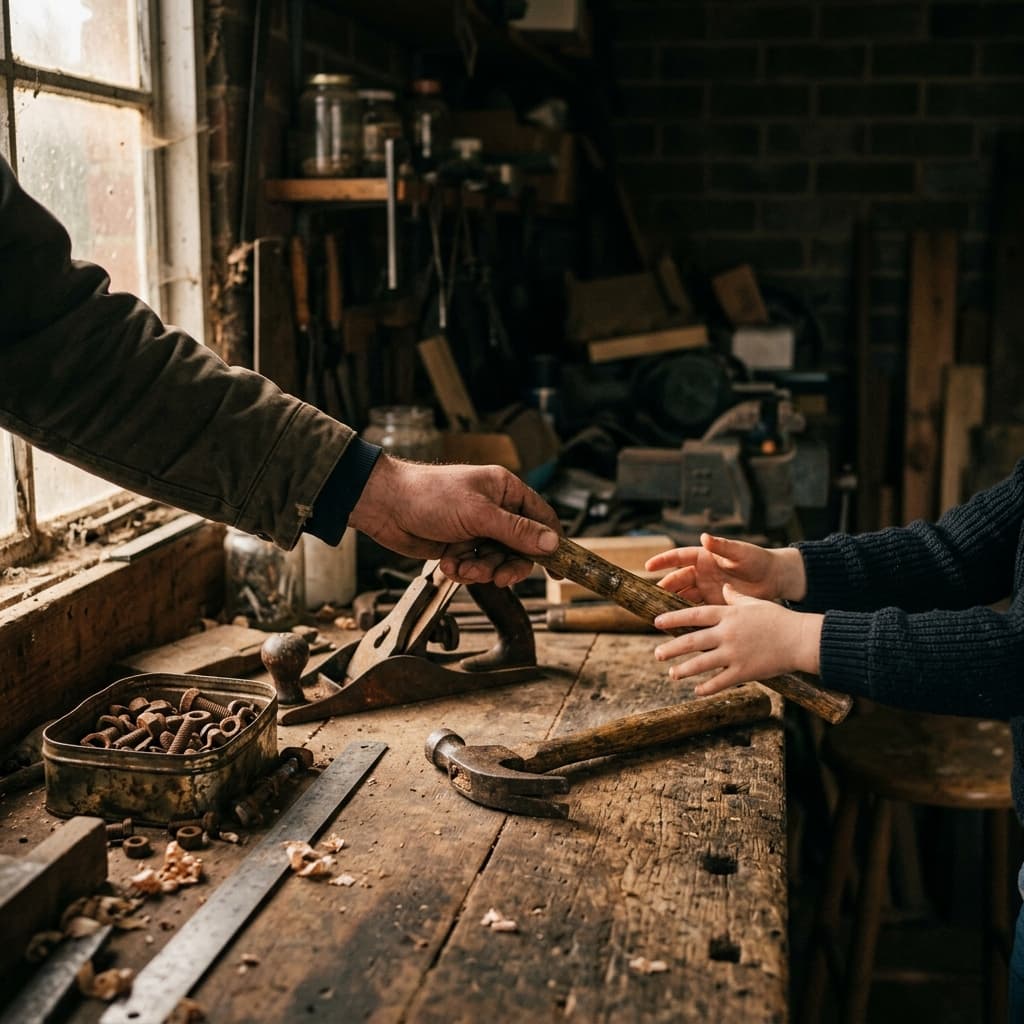
Before you have to find the right words — before your grief is organized enough to say anything coherent — there are things. A well-worn tool. A fishing rod. A record he played too loud on Saturday mornings. A piece of handwriting on the back of an old card. These don't require you to have it together. They require you to hand something over and say, "This was his."
The garage full of "useful" junk that felt like a problem after he died? It's an asset now. The password-protected iPad, the coffee mug with the company logo from a job he retired from fifteen years ago, the tackle box organized in a way only he understood — these objects outlasted him, and they carry information about who he was that you can't quite put into sentences yet.
A kid touching a grandfather's hammer is a form of introduction. Framing matters. Not "this is old stuff" but "this is what he used to fix things around the house — he was pretty convinced he could fix anything, whether or not he actually could." That second version gives the object a personality. The grandfather starts to take shape.
Don't wait until the objects feel meaningful. For a while, they might just feel like clutter. Use them anyway.
Tell the Stories That Don't Flatter Him
Hagiography kills connection. If your kids only ever hear that Grandpa was wise, generous, and devoted to family, he's going to sound like a LinkedIn profile written by someone who didn't know him.
The stories that make him real are the ones where he was wrong about something. Where he made a meal that was genuinely bad but refused to admit it. Where he had a strange, embarrassing obsession — with a particular sports team, with a specific brand of tool, with a way of doing something that was objectively inefficient but he'd been doing it since 1978 and wasn't about to stop. Where he said exactly the wrong thing at exactly the wrong moment and everyone at the table went quiet.
That's the texture of a person. Kids recognize it immediately, because they know adults are not actually wise and generous all the time. When you tell them a story where Grandpa screwed something up, their eyes come on. He becomes somebody.
The Dead Dads Podcast runs on exactly this principle. The tagline is "Death. Jokes. Closure. Not always in that order." Humor isn't a way of avoiding grief — it's evidence that the person was human. If you can laugh at a story about your dad, that story is doing more work than any solemn tribute. For more on this, How to Use Dark Humor When Your Dad Dies — and Stop Feeling Guilty About It goes deeper into why the impulse to find things funny is not something to apologize for.
Tell your kids about the time he was wrong. Tell them about the thing he always said that made no sense. Tell them about the argument you never finished. Those stories keep him in the room.
Build Rituals Around Things He Taught You
The most durable transmission isn't a scrapbook. It's a habit.
Cooking his recipe — the one he made badly but made often enough that it became the thing you think of when you think of Saturday afternoons. Using his tool the way he showed you, even if there's probably a better way to do it by now. Watching the team he watched, not because you particularly care about the team, but because caring about the team is something you inherited. These rituals create ongoing contact with who he was, not just a single memorial moment that you revisit once a year.
This matters more than people expect, especially for men who are now fathers themselves. There's a specific kind of silence that happens when you reach for advice — real, actual advice, the kind that comes from someone who knows your history — and realize there's no one to call. That gap is where a lot of men go quiet. If you're navigating that, How to Be a New Dad When You Can't Call Yours for Advice is worth reading.
The rituals matter for your kids for a different reason. Children absorb more from repeated small moments than from formal sit-downs. A single "let's talk about Grandpa" conversation is harder to sustain than watching the same team every Sunday and saying, "He would've had opinions about that call." One is a presentation. The other is a relationship — even if it's a relationship with someone who isn't there.
Think about what he actually taught you, even implicitly. The way you hold a particular thing. The way you approach a problem. The things you say that sound like things he said. Make those visible to your kids. Name them. "I do it this way because of him" is a sentence worth saying out loud more than once.
Create a Physical Record While You Still Can
Memory degrades faster than people expect. Not all at once — it erodes. The specific quality of his voice. The exact way he laughed. The detail of a story you've told fifteen times but can't quite reconstruct anymore.
A physical record doesn't have to be a project. It can start as a notes app on your phone, opened on a Tuesday when something surfaces unexpectedly. Write it down before the edges go soft. Photos, a piece of his handwriting, the date he died, one moment you still think about — that's enough to start.
Bruce Feiler's research, cited in the New York Times in 2013 and referenced extensively at Family Locket, found that children who knew their family stories — the full arc, including the hard parts, not just the heroic version — showed greater resilience across psychological measures. Not marginally greater. Significantly. The kids who knew where their family came from, what their people had been through, handled difficulty better than the kids who didn't. The record itself is doing something.
A memory book — even a simple one — gives your kids something to return to at 15, at 25, at 40, without needing you to perform your grief on demand every time they're curious about him. That's the practical argument for making one. Not sentiment. Not craft projects. Just the fact that you will not always be in the room when they want to know who he was, and the book will be.
Legacy projects don't require expertise or a particular kind of grief literacy. They require writing things down before you forget them. Start with one story. The rest follows.
Give Them Permission to Grieve Someone They Never Lost
This one catches parents off guard.
Kids can feel a real, specific sadness about a grandfather they never met — particularly when they watch friends interact with theirs. The birthday parties where someone's grandfather is there, teaching them something, being embarrassing, being present. Your kid notices. They might not say anything about it, but they notice.
The temptation is to minimize it. "Well, you never really knew him." That sentence closes a door. It tells the kid that what they're feeling doesn't quite count, that grief requires a minimum level of prior relationship to be valid. It's not true, and kids know it isn't true even if they can't articulate why.
Name it instead. "It makes sense that you feel that. I wish you had known him too." Then let them ask questions, including the hard ones — how he died, what he was actually like, whether he would have been a good grandfather (honest answer required), whether you miss him. Don't manage those questions toward a comfortable conclusion. Just answer them.
The Dead Dads website has a "leave a message about your dad" feature for exactly this reason — because sometimes you need somewhere to put the thing you can't quite say to another person. Show your kid that feature. Let them use it. Talking to someone who isn't there is not a strange thing to do. It's actually one of the more honest things a person can do with grief.
The Trap to Avoid
Turning this into a memorial project is the most common mistake.
Scrapbooks and legacy boxes are useful, but if the only context your kids get for their grandfather is grief-adjacent — the memory book on his birthday, the photo on the mantle that no one mentions unless someone asks — he stays frozen. He becomes a concept rather than a character. A thing to be respected rather than a person to know.
The goal isn't to preserve loss. It's to integrate a real person into ordinary family life. The difference is whether his name comes up in a regular Tuesday conversation, not just on solemn occasions. Whether you reference him when something happens that would have made him laugh, or annoyed him, or sent him off on one of his particular tangents.
He doesn't have to stay in the past tense. He can just be someone who isn't here right now — which is different, and true, and gives your kids a different relationship with his absence.
If you haven't talked much about this — with anyone, not just your kids — the Greg Kettner episode of the Dead Dads Podcast is a good place to start. It's for men who haven't said much yet. You can also leave a message about your dad at deaddadspodcast.com — no audience, no performance required. Just the thing, said out loud.
Get the latest from The Fatherless Manual delivered to your inbox each week
More from The Fatherless Manual

How to Navigate Social Situations When You Grieve With Humor, Not Tears
You made a joke about your dad at the family dinner — a good one, actually — and the room went quiet like you'd said something terrible. That silence is its own
Why Grief Support Groups Fail Men — And What Is Quietly Replacing Them
Nearly a quarter of men say they would never consider professional therapy for mental health struggles, even when they're in crisis. Not because they don't need
How to Find Grief Support That Actually Works When Therapy Felt Wrong
Most men who try grief counseling don't quit because they're not ready to heal. They quit because the format assumes they grieve like someone who has never once