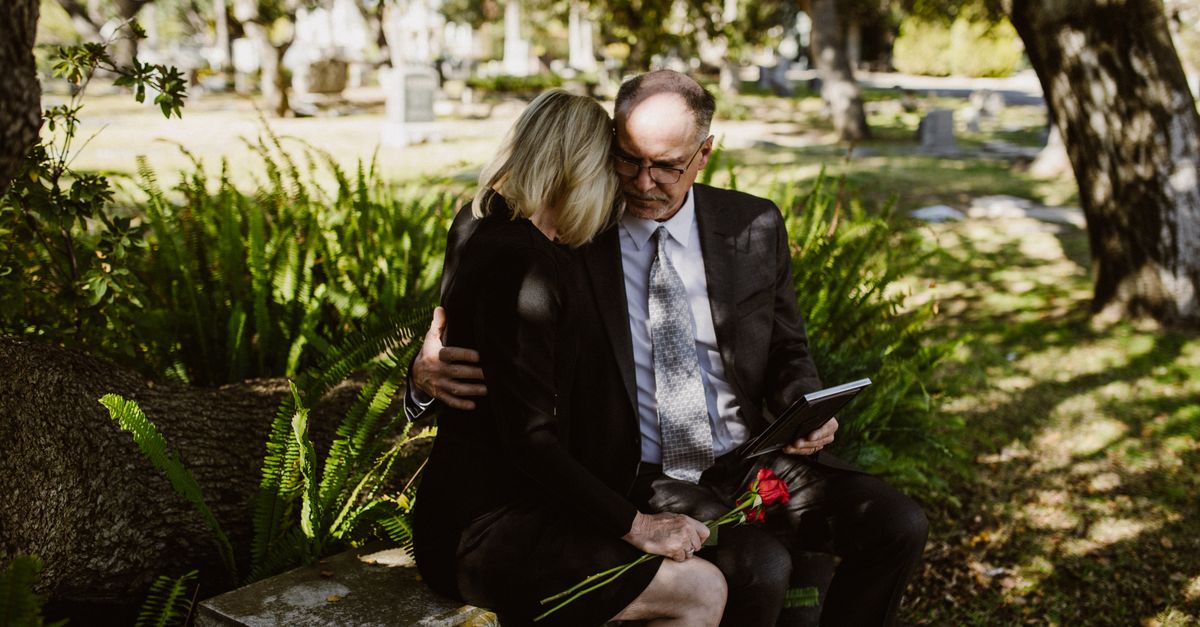
Most men who lose a father don't get the Hollywood deathbed scene. They get a phone call on a Tuesday. Or they leave the hospital to handle a work thing and never make it back in time. And then they spend years carrying words that had nowhere to go.
One listener wrote about his father passing just before Christmas 2025. He described the grief as something he'd been bottling — not talking about, not naming. "It's the type of pain that I bottle up and keep to myself," he wrote in a review of the Dead Dads Podcast. "I felt some pain relief..." The sentence trails off there, but what's in it is enough.
The thing nobody tells you is that the grief of what was left unsaid can sit separately from the grief of the loss itself. They layer. One is about your dad being gone. The other is about you — about the version of you that never got to say the thing, and now has to figure out what to do with it.
The Goodbye You Imagined Versus the Goodbye You Got
Most of us carry a mental script for how a final goodbye is supposed to go. The moment of lucidity. The hand held, the right words said at the right time. Eyes open. Recognition. Something exchanged that means something.
On the Dead Dads Podcast, a guest described sitting beside his father's bed in palliative care, his dad deep in the fog of dementia, and what he remembered most from that time was "desperately hoping that there would be a moment of lucidity." And then: the disappointment that it didn't come. Not disappointment that his father was dying — he'd had time to prepare for that, had visited regularly, had been present. The disappointment was specifically about the scene that never happened. "That last moment you kind of have this Hollywood sense of how it's gonna go," he said. "Didn't go that way."
That distinction matters. He didn't feel deprived of his father's company. He felt deprived of the ending he'd unconsciously written. And those are two different kinds of pain, even when they arrive in the same week.
Some men leave the hospital for a work commitment — a genuine, reasonable decision, given the uncertainty of how long things will take — and get the call while away. That sounds like something you'd regret, and maybe on some level it stays with you. But the circumstances weren't a character flaw. They were Tuesday.
Why Unfinished Goodbyes Hit Differently — and Why That's Not Weakness
There is a psychological reason the unfinished goodbye keeps surfacing. According to RM Counselling, humans are wired to resolve incomplete situations. When things end in a complete way — even if it's not the outcome we wanted — we're generally more able to integrate them and move forward. When they don't, what results is what therapists call unfinished business: an unresolved state that doesn't just feel sad, but actively drains energy. Focus scatters. You find yourself distracted in ways that are hard to explain to people who haven't been there.
What's Your Grief uses a musical metaphor for this: dissonance. A chord made of notes that don't resolve creates tension in the listener — an instinctual need for it to land somewhere. Things left unsaid work the same way. They're unstable. They create internal tension until they find somewhere to go.
What compounds this for men specifically is the way regret gets conflated with failure. Regret implies you did something wrong. But most men who didn't get to say goodbye weren't negligent. They were at work. They were managing the logistics. They were protecting someone else, or they simply trusted there would be more time. Those circumstances don't make someone a bad son. They make someone human.
And the pain of unsaid words doesn't care whether the death was sudden or anticipated. A heart attack gives you no warning. But dementia, illness, years of slow decline — those can leave the same hole. Lucidity disappears before the end comes. You were present for all of it and still didn't get the scene. That's its own specific grief, and it's worth naming it as such rather than dismissing it because you "had time to prepare."
The Psychology Today piece on not getting to say goodbye is useful here for one reason: it acknowledges the psychological weight of the missing farewell as real and significant, not as a sign that something is wrong with you for caring about it. That's worth holding onto.
What You Can Still Do With the Words That Are Still in You
Here is the reframe that actually helps: just because someone is gone doesn't mean the expression of what you felt has to die with them. This isn't about getting closure — be careful about anyone who promises that. It's about giving the words somewhere to go, rather than letting them pile up internally.
Write it anyway. A letter, unsent, addressed to your dad. Not for him. For you. The act of writing to someone who can no longer respond has been documented as genuinely useful — not as a cure, but as a way of externalizing what's been trapped. As Pachamama Tributes notes, writing doesn't require an audience. You start with "I miss you" if that's all you have. You say what you would have said. You don't need it to be eloquent. Memories of Life describes this as love that's still trying to find a voice — and writing is one of the few forms of expression that doesn't require anyone to receive it to still be real.
If the idea of journaling feels foreign, there's a related post on why writing after losing your dad actually works — it breaks down the mechanics without making it sound like a wellness exercise.
Say it out loud. To someone who knew him. To nobody. During the Dead Dads Podcast episode with guest John Abreu — a man who received the call about his father's death and then had to sit down with his family to tell them — the conversation kept circling back to one thing: the value of talking about the person afterward. "If you don't get to talk about the people, then they do disappear," the guest said. "Better to talk about them after than not. You don't want to keep that bottled up, because then the next generation won't recall."
Saying your dad's name, telling a story about something he did, describing the specific way he drove — none of that is morbid. It's the opposite. It's what keeps someone from disappearing.
Leave a message about your dad. The Dead Dads Podcast website has a built-in feature for exactly this — visitors can leave a message about their dad, without an audience, without a structure to follow. It's a low-stakes way to say the thing that's been sitting there. If the unsaid words have been building and you're not sure where to put them, that's as good a place as any to start. Visit deaddadspodcast.com and look for it there.
Let the grief be non-linear. The words you didn't say might surface while you're in a hardware store. On a drive. Years from now, when your own kid says something that sounds exactly like your father would have. That's not regression. That's not failure to process. That's how grief actually works when there's unfinished business attached to it — it resurfaces not because you're broken, but because the relationship mattered, and the missing piece keeps reminding you of its absence.
Books That Don't Promise Closure
Three books are worth having nearby, not because they'll fix anything, but because they won't pretend to.
It's OK That You're Not OK by Megan Devine doesn't tell you how to move on. It tells you that grief is not a problem to be solved. That framing alone can be useful when everyone around you is waiting for you to be "better."
The Dead Dad Club by Matt Haig names the specific strangeness of losing your father — the odd club nobody applied to join, but membership comes with a shared experience that doesn't need a lot of explaining between members.
A Grief Observed by C.S. Lewis was written in real time, in the immediate aftermath of loss. It's raw rather than resolved. It's useful precisely because Lewis doesn't arrive at tidy answers — he just keeps thinking out loud, honestly, on the page. For anyone who feels like grief is taking too long or going in circles, watching Lewis do the same thing in 1961 is quietly reassuring.
None of these are feel-good reads. That's the point. You don't need someone to tell you it gets easier right now. You need someone to sit in the room with you.
What "Peace" Actually Looks Like Here — and What It Doesn't
This is where it's worth being honest about the premise.
Peace after an unfinished goodbye doesn't mean you stop wishing you'd said it. It doesn't mean the hardware store stops being a problem on a bad day. It doesn't arrive on a schedule, and it rarely announces itself clearly when it does arrive. The Dead Dads tagline — "Death. Jokes. Closure. Not always in that order" — is funny because it's precise. Closure, when it comes at all, tends to arrive sideways, late, and not quite in the form you expected.
What peace actually looks like, in practice, is stopping the punishment. The replaying of the phone call you should have made, the hospital visit you should have extended, the things you should have said at dinner six years ago. That loop is not grief. That loop is self-prosecution, and it's a separate problem from grief.
Grief isn't something you solve. It's something you learn to live alongside. That's not a consolation prize — it's actually the more accurate description of what survival looks like, and once you stop expecting it to be resolved, the carrying of it becomes a little less exhausting.
The family from the palliative care visit described earlier — the one that got a noise warning for having too much fun in the hospital room, whose sister snuck in a bottle, who celebrated a birthday "unbeknownst to him" — that family didn't get the Hollywood goodbye either. They got something else: time together, laughter in a hard place, a story they'd be telling for years. It wasn't the scene anyone scripted. But it wasn't nothing.
If you're in the middle of this — recently lost, or still carrying something from years back — the Dead Dads episode with John Abreu is a good place to start. He received the call about his father's death and then had to sit down with his family to tell them. The conversation that follows in that episode is exactly the kind that Roger Nairn and Scott Cunningham built the show to have — because as they wrote in the founding blog post, they started it because they couldn't find the conversation they were looking for.
If you haven't gotten to that conversation yet either, you're in the right place.
For men processing not just the goodbye but the relationship itself — the complicated parts, the things your father never heard from you and the things you never heard from him — How to Forgive Your Dad After He's Gone When He Can't Hear You covers the specific work of that.
You're not broken. You're grieving. Those are different things, and it matters to keep them separate.