How to Be a New Dad When You Can't Call Yours for Advice

The Dead Dads Podcast
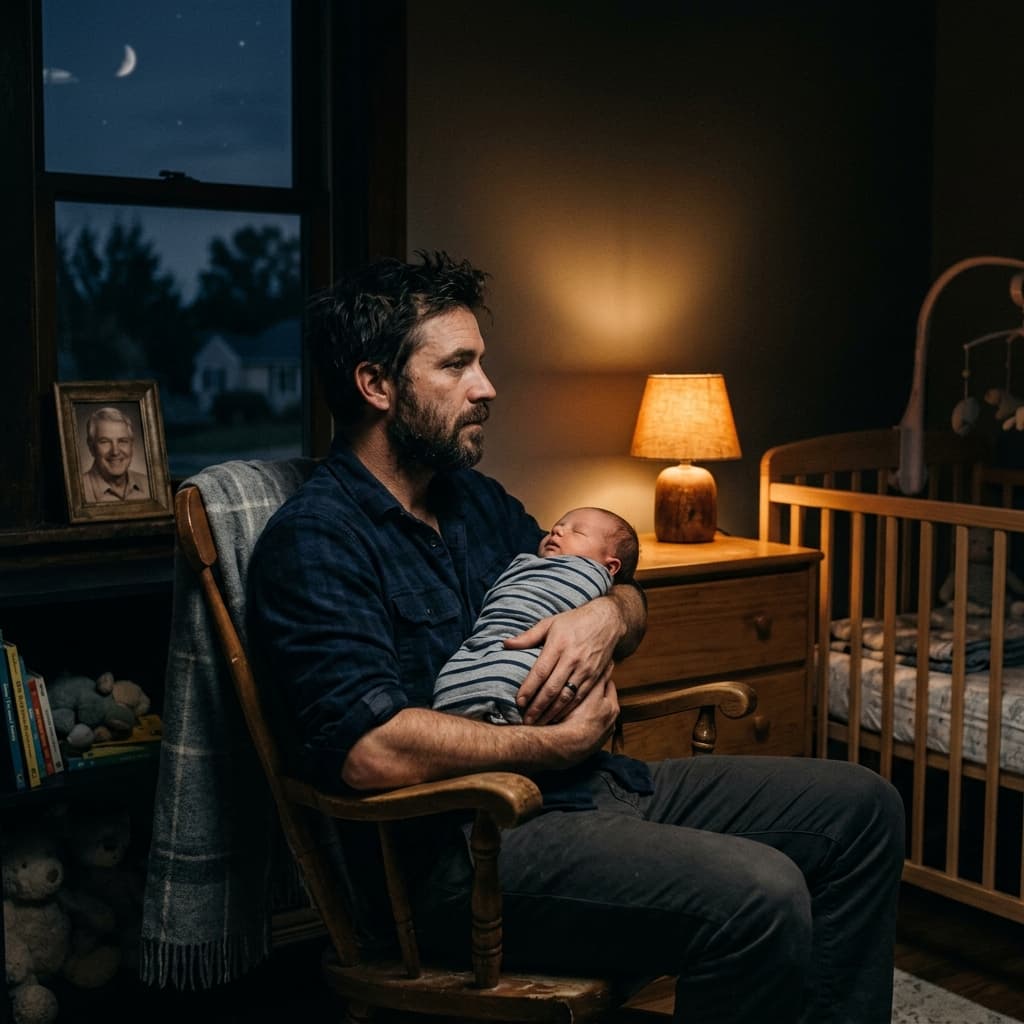
The baby lands in your arms and your first instinct is to call your dad. Not a therapist, not a parenting book author, not a Reddit thread. Your dad. Then the whole thing lands differently, because he's gone, and this moment — which should be the fullest of your life — has a hole in it the shape of a man who will never see this.
That's not a detour in new fatherhood. For a lot of men who've lost their fathers, that's the whole terrain.
This isn't a guide about surviving grief. It's about what happens when grief and new parenthood run on the same track at the same time — which is messier, stranger, and lonelier than either one on its own. If that's where you are right now, this is written directly for you.
The Thing No One Calls by Its Right Name
There's a term for what you're experiencing: milestone grief. It's the way loss resurfaces — sometimes gently, sometimes like a wall — at major life events. A graduation. A wedding. The birth of a child.
Becoming a dad is arguably the biggest trigger there is. The role of father is, almost by design, built in reference to your own father. You're entering a territory that he mapped first. Every question you have, every moment of self-doubt, every time your kid does something that makes your chest crack open — those are all moments where the mental reflex is to reach for him.
And when he's not there, it doesn't feel like grief in the way people usually describe grief. It doesn't feel like sadness exactly. It feels like absence. Like a signal going out and getting no response.
Research into suppressed male grief consistently shows that when men don't have language for what they're feeling, or don't have permission to feel it, the emotions don't dissolve — they go somewhere else. They show up as irritability, distance, a low-grade numbness. New fathers already face a significant identity shift. Add unprocessed loss on top of that and the weight can become genuinely hard to carry.
The Dead Dads Podcast puts this plainly: grief doesn't live only in the funeral. It hits in the hardware store. It hits at 2am with a screaming infant. It hits the first time your kid does something your dad would have loved. Milestone grief is real, it's specific, and it is not a sign that something is wrong with you. It's a logical response to a real absence in a moment that made that absence loud.
The Practical Gap Is Real Too
Part of what makes this hard is that it's not only emotional. There's a genuine practical gap.
Your dad, whatever his limitations, was a reservoir of lived experience. How to fix a leaky tap. What a fever actually looks like versus when you panic. How to get a kid to sleep in a car. What to do when you feel completely underwater and don't know why. A lot of that knowledge doesn't live in books. It lives in conversations. In the easy offhand advice that comes from someone who went through exactly what you're going through.
According to Vibrant Dad's new father research, 85% of fathers in high and middle-income countries say they want to be hands-on with their newborns from day one. The intent is there. The confidence often isn't. And confidence, it turns out, comes from repetition and guidance — not from reading a manual in isolation at midnight.
For men who've lost their fathers, that gap in guidance can feel disproportionately sharp. It's not that other men have it figured out. It's that some men have a phone call they can make at 11pm when the baby won't stop crying and they don't know what to do next. You don't. That's not self-pity. It's accurate.
The practical and emotional are tangled here in a way that's worth naming. Every time you hit a practical wall — every time you don't know the answer to something and realize there's no one to call — you're also hitting the grief again. The two aren't separate experiences. They're the same moment.
The Quiet That Gets Loud at 2am
The particular texture of grief during new parenthood has a timing problem. New fathers are sleep-deprived, stretched thin, often running on obligation and adrenaline. There isn't a lot of space for feelings to get processed. They get postponed.
And then, inevitably, they don't stay postponed.
Late-night feeds are when it tends to arrive. You're sitting in the dark with this small, new, demanding person. The house is quiet. There's nothing to distract you. And the thought surfaces — my dad never got to meet this kid. Or: I have no idea what I'm doing and the one person who would just know isn't here.
Men grieve privately and often silently, particularly in cultures that read emotional expression as weakness. Research from Share Parents of Utah on fatherhood and grief points out that fathers frequently suppress grief to maintain the appearance of holding things together — for their partners, for their families, for anyone watching. The emotions don't disappear. They move. They show up as anger, as distance, as a flatness that's hard to explain.
For new dads who are also grieving fathers, the pressure to be "the strong one" is doubled. You're supposed to be present for a new baby. You're supposed to be supportive of your partner. And simultaneously you're carrying something that you haven't told most people about because there's no obvious time or place to bring it up.
That quiet gets loud eventually. The question is whether you've built anything to catch it.
What You're Actually Looking For
This is where it helps to get honest about what you need, because it's probably not what you think you need.
You don't need a replacement dad. You don't need someone to tell you what your father would have said. What you need is the experience of not being alone in this — specifically in this intersection of grief and new parenthood, not just one or the other.
Conversation with men who've been through the same specific combination is worth more than almost anything else. Not advice. Not information. Just the recognition that comes from hearing someone else describe exactly what you're going through and saying: yes, that happened to me too.
This is the gap that podcasts like Dead Dads were built for. Hosts Roger Nairn and Scott Cunningham both lost their fathers, and the show was created specifically because they couldn't find the conversation they were looking for. Episodes like the one featuring John Abreu — who had to take a call about his father's death and then sit down with his family to tell them — aren't clinical. They're not therapeutic frameworks. They're just men talking about what it actually felt like. That alone has value that's hard to quantify.
Listener feedback on the show captures something specific: "I felt some pain relief," wrote one listener who described bottling up grief since losing his father. That's not a small thing. Pain relief through recognition — through someone else saying the thing out loud — is a meaningful first step.
Building the Network You Actually Need
Practically, here's what tends to help.
First: find men who have been through it. Not men who are vaguely supportive, not friends who say "I can't imagine," but men who actually lost their fathers and kept moving. They don't have to be at the same stage of parenthood. They just have to have been somewhere in the vicinity of what you're going through. That specific overlap — dad loss plus fatherhood — changes the nature of the conversation.
Second: give yourself permission to process this in pieces. You are not going to resolve your grief during the first year of your child's life. That year is too full and too exhausting for deep emotional reckoning. What you can do is create small, specific spaces where you're not performing okayness. A podcast you listen to alone. A conversation with one friend who actually gets it. A walk where you let yourself think about your dad without immediately moving on.
Third: consider what your father actually passed on, even if he's gone. This sounds abstract, but it's concrete in practice. The way he approached a problem. Something he always said. A value that shaped the way you move through the world. You have more of him than you think. Naming that — literally writing it down, or saying it out loud to your partner — turns it into something you can use. Into something you can eventually pass on yourself.
This is the territory that the Deep Dive Parenting framework on absent fathers also touches on: the past shapes how you show up as a father, whether you're aware of it or not. Making it conscious doesn't erase it. It just gives you more control over what it becomes.
The First Time Your Kid Asks About Him
At some point, your child is going to ask about their grandfather. Not soon — not in year one. But eventually.
Start now with how you want to answer that. Not the words exactly, but the spirit of it. Because the way you carry your father — with bitterness or pride or grief that's been allowed to exist openly — will shape how your child understands both death and love.
You're not just learning to be a new dad. You're learning to be the link between two generations, one of which is gone. That's a specific and heavy thing. It's also, if you let it be, a worthwhile one.
If you're in the early stages of trying to name any of this, the Dead Dads Podcast episode with Greg Kettner is a useful place to start. Real conversation from men who are figuring out the same road.
For more on how grief resurfaces — and why dark humor isn't something to feel guilty about when it does — this piece on how to use dark humor when your dad dies covers what that actually looks like in practice.
You're not behind. You're not broken. You're just in the part where it's hard and there's no roadmap, and the person who would have had some thoughts about that isn't available to share them anymore. That's the whole thing. And you're not the only one living it.
Get the latest from The Fatherless Manual delivered to your inbox each week
More from The Fatherless Manual

How to Navigate Social Situations When You Grieve With Humor, Not Tears
You made a joke about your dad at the family dinner — a good one, actually — and the room went quiet like you'd said something terrible. That silence is its own
Why Grief Support Groups Fail Men — And What Is Quietly Replacing Them
Nearly a quarter of men say they would never consider professional therapy for mental health struggles, even when they're in crisis. Not because they don't need
How to Introduce Your Kids to the Grandfather They'll Never Meet
Your kid is going to ask about him. Maybe they already have — the casual, devastating "What was Grandpa like?" lobbed from the backseat on the way to soccer pra