The first time you use one of his tools, you'll hold it wrong. And then, suddenly, you won't. That's when it gets weird.
That moment — the muscle memory clicking into place, the grip settling — is not something you can think your way into. It just happens. And when it does, the room gets a little smaller and a little fuller at the same time.
Every Dad Had a Domain
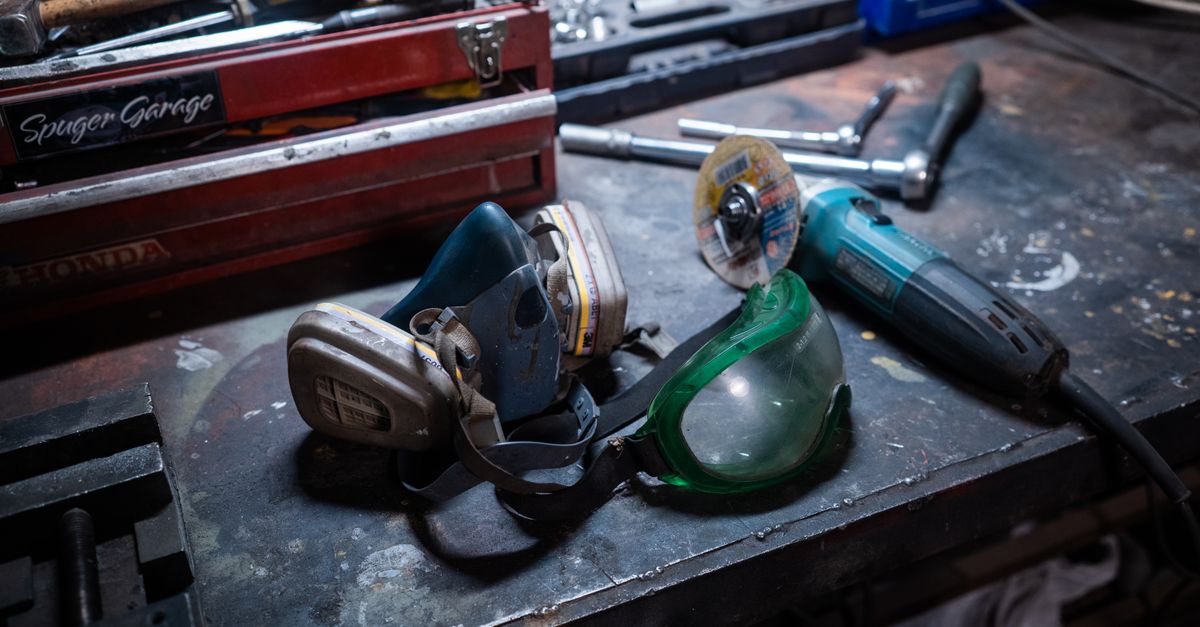
Maybe it was a garage. Maybe it was a shed with a specific smell — WD-40, sawdust, old oil, something unidentifiable but completely his. Maybe it was a tackle box kept under the stairs, or a basement workbench lit by a single bulb, or just the corner of the backyard where he kept the tools he swore he'd get around to using.
Whatever the space, it was his. And now it's yours to deal with.
That's a specific kind of paralysis that doesn't get talked about much. You stand in that room and everything is exactly where he left it. The tools are on their hooks. The extension cords are half-coiled the way only he coiled them. There's probably a project he started and never finished — a half-sanded something, a screw still waiting on a shelf next to the thing it was supposed to go into.
The space has been frozen. You haven't.
That gap — between the stillness of his stuff and the fact that your life kept moving — is one of the stranger parts of losing a father. You've had to keep going. The garage hasn't. And walking into it feels like stepping back into a timeline that diverged the moment he died.
Keeping His Stuff Versus Actually Touching It
A lot of men become curators. The tools stay on the hooks. The fishing rods don't leave the wall. The workbench gets a thin layer of dust, and nobody touches it, and somehow that feels like the respectful thing to do.
There's a real pull toward that. Treating his space like a museum, keeping everything exactly as it was. It feels like preservation. Like loyalty.
But there's a cost.
Farley Ledgerwood, writing about clearing his father's garage, described finding pristine power tools still in their boxes — chisels that had never touched wood, hand planes wrapped in oiled cloth. His father had spent thirty years buying tools for "someday" and died at sixty-seven before that day arrived. Three decades of postponed intention, stacked in a garage.
That story hits differently when you're standing in a similar room looking at similar things.
Because here's what nobody says out loud: leaving everything in place can be its own kind of avoidance. It can look like honoring him while actually being about not being ready to feel what happens when you pick something up.
Using his stuff isn't the opposite of honoring him. It's closer to the opposite of forgetting him. A relic sits behind glass. A living thing gets used. And the tools he bought, kept, worked with — those were living things in his hands. They can be again.
There's a meaningful difference between selling them off (which is its own complicated conversation) and keeping them frozen versus actually putting them to work. The third option is the one that takes the most nerve and gives the most back.
Being Bad at It Is the Whole Point
Here's where it gets honest and a little funny.
You are probably not going to be good at this.
If he was a woodworker, you're going to measure wrong. If he fished, you're going to tangle the line, pick the wrong lure, and sit quietly next to a body of water catching absolutely nothing. If he gardened, you'll kill things that look easy to keep alive. You'll use the wrong drill bit. You'll overcook the fish. You'll replant something in the wrong season.
That's not failure. That's contact.
One guest on a Dead Dads episode put it plainly when asked what he'd inherited from his father. "Frighteningly," he said, before admitting: "I love puttering around the garden and I'm terrible at it. Jack of all trades, master of none." He knew it. His wife and kids made fun of him for it. He defended himself in company and knew he was lying. The thing he'd sworn he'd never become, he'd become — and it had his father all over it.
That moment of recognition — the slightly horrifying, slightly funny realization that you've absorbed something from him without trying to — is exactly what picking up his hobbies can give you.
You don't need to get good at it. You don't need to finish the project or catch the fish or grow anything edible. Mediocrity is fine. Being a beginner is fine. The point isn't competence. The point is that you're doing the thing he did, in the approximate way he did it, and some part of that is a conversation with him that words couldn't hold.
For more on how this kind of accidental inheritance works — and what you do with it — How to Carry Your Father's Legacy Forward Without Forcing It is worth your time.
Grief Is Hiding in the Middle of the Task
Nobody warns you about this part.
You're sanding something. Or you're reorganizing the tackle box, separating lures by size the way he always did. Or you're standing in the paint aisle trying to figure out which finish he would have picked, and you turn around to ask him — and then you remember.
The Dead Dads show talks about "the grief that hits you in the middle of a hardware store." That's not a metaphor. That's a real, specific thing that happens when you're least defended. You're not sitting with it. You're not journaling about it. You're looking at sandpaper grits and then suddenly you're not fine.
That's not a problem to manage. That's the relationship still working.
Grief doesn't need a ceremony to arrive. It shows up inside ordinary actions, which is actually appropriate — because your relationship with your father was mostly made of ordinary actions. The Saturday morning trips. The specific way he held a tool. The sounds he made when something didn't fit right. None of that was ceremonial. All of it was real. So grief finds you the same way.
Let it. Seriously. The impulse is to push through, get back to the task, not make it weird. But if you're alone in that garage and something hits you — let it land. You don't have to perform grief or schedule it or process it correctly. Standing in his space, holding his things, and just feeling it for a minute is not weakness. It's the only honest response.
Eiman A, a listener who wrote in after hearing Dead Dads for the first time, described it exactly: "It's the type of pain that I bottle up and keep to myself. I felt some pain relief when listening to you guys, and it feels a little better knowing I'm not the only one going through these feelings." That relief comes from contact — with the grief, with other people who get it, with the stuff that carries the memory.
The mid-task grief hit is the relationship still active. That's not a sign something is wrong. That's a sign something is still there.
If you want to understand more about what grief does when it shows up sideways — not during the eulogy, but in the middle of regular life — When Grief Gets Weird: The Symptoms Nobody Warns You About After Losing Your Dad covers the terrain honestly.
His Hobbies as a Bridge Forward
This part requires a shift in angle.
Pickup his hobby, and you're looking backward — toward him, toward memory, toward the shape of who he was in the world. That's real and that's valid. But the same action can also point forward.
Scott Cunningham, co-host of Dead Dads, wrote about Dairy Queen. It's the kind of story that sounds small until you realize what it actually is. Dairy Queen became synonymous with his dad. So it became the ritual. His kids remind him weeks in advance — "Is it time to go to Dairy Queen yet? I want a Blizzard! When was Papa born again?" A Blizzard became the occasion to talk about his father again, without forcing it, without the rolling eyes you get when grief feels like a lecture.
That's the mechanic. The thing you inherit — the hobby, the place, the ritual — becomes the vehicle for passing him forward.
If you're a woodworker now, even a bad one, you're going to show your kids what you're doing. You're going to use his tools. And at some point, one of them is going to ask where the tools came from. That's the door.
The hobby doesn't just connect you to your father. It connects your kids to a grandfather they're losing or have lost. Not through obligation, not through a formal sit-down conversation about loss, but through the natural context of doing something with your hands and talking while you do it.
One Garage Journal forum member, clearing his father's workshop after he died, put it simply: "They'll join in, getting used for a few more decades of fixing, building, and tinkering." That framing — tools as something that accumulate decades, that outlive their original owners and pass meaning through use — is exactly right. The tool doesn't know it belonged to him. But you do. And so will whoever stands next to you when you use it.
This is why picking it up matters in a way that keeping it on the hook does not. A tool behind glass is a memorial. A tool in your hand is a continuation.
His domain doesn't have to stay frozen. It can become yours — not instead of his, but because of his. You're allowed to use the space, modify it, add to it, even make it your own. That's not erasure. That's what he would have wanted the stuff to do.
And one day, if you're patient and bad at it for long enough, you'll reach for a tool and hold it exactly right without thinking about it. That's when it gets weird. That's also when it gets good.
Dead Dads is hosted by Roger Nairn and Scott Cunningham — two guys who lost their fathers and started the conversation they couldn't find anywhere else. New episodes on Spotify, Apple Podcasts, and YouTube.