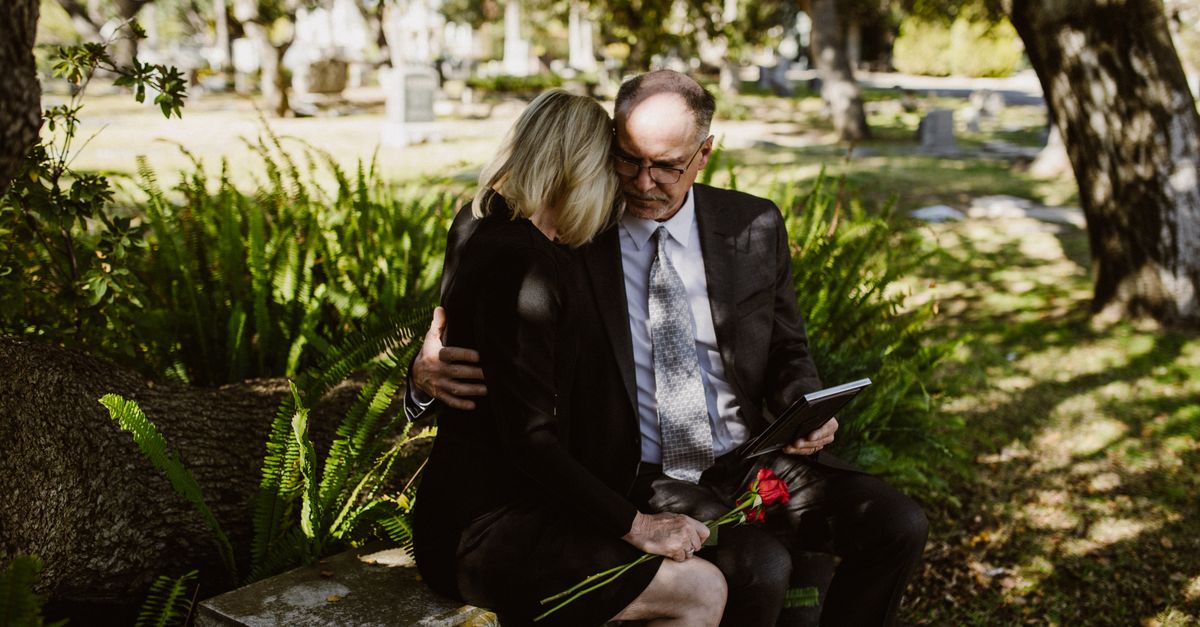

Here is what no one says out loud: some men spend years — quietly, privately — rehearsing a conversation that will never happen. The confrontation. The explanation. The moment where he finally admits it, or you finally say what you needed to say, and something between you gets resolved. That rehearsal is exhausting. And the death makes it permanent.
Forgiveness, the way most of us understand it, is a two-person transaction. Someone wrongs you, time passes, there is an accounting, and then — if things go well — a resolution. The problem with forgiving a dead father is that one seat at the table is empty. It will always be empty. And that is a specific kind of grief that doesn't get named very often.
The Door That Closed Before You Were Ready
Most ruptures in adult relationships carry at least the theoretical possibility of repair. A friendship that went cold. A falling-out with a brother. Even a divorce carries, in many cases, some version of a post-mortem conversation — a reckoning that both people can participate in. Father loss, when the relationship was complicated, removes that possibility entirely.
This is what psychologists call "complicated mourning." You're not just grieving the man — you're grieving the conversation you didn't get to have, and the version of the relationship that never existed. That second loss is often harder to name, and therefore harder to process. The anger doesn't have anywhere obvious to go.
What makes it worse is that death has a way of pressuring men toward premature peace. Speak well of the dead. He did his best. He wasn't around much, but he provided. These reframings are sometimes true and sometimes not — but they're almost always offered too fast. The grief is still raw and someone's already handing you a resolution you didn't earn and didn't ask for.
Sitting in the reality that the door closed before you were ready is not self-pity. It's honesty. And it's where any real reckoning with a complicated father has to begin.
The Forgiveness You Were Sold Is the Wrong Kind
There are two fundamentally different kinds of forgiveness, and conflating them is the source of most of the confusion men carry around this.
The first is transactional forgiveness. This is the version most of us learned — the apology accepted, the mutual understanding reached, the relationship restored or at least acknowledged. It requires both people. It requires the person who caused harm to show some degree of recognition, remorse, or change. It is the version depicted in almost every film where a son finally confronts his father and something gets healed. As Roger Nairn and Scott Cunningham have noted on Dead Dads, grief comes loaded with what they describe as "Hollywood-esque, pre-subscribed notions" of what resolution is supposed to look like. Forgiveness is no different. We're sold a cinematic version and then feel like failures when our actual experience doesn't match it.
The second is internal forgiveness. This one requires only you. It's not about deciding his behavior was acceptable, or that the damage he caused didn't matter. It's about deciding that the weight of carrying unresolved resentment is costing you more than it's costing him — and that you're done paying that price. Robert Enright, writing in Psychology Today, makes a useful distinction: reconciliation requires the other person's participation, but forgiveness does not. You can forgive someone who cannot hear you, cannot respond, and cannot change. You can forgive someone who is dead.
The catch is that this kind of forgiveness doesn't feel like what we were promised. It doesn't arrive as peace. It doesn't erase the specific memories of specific failures. Enright also notes that when forgiveness is practiced genuinely, some residual anger is normal — even expected. The question isn't whether the anger is gone. The question is whether the anger is running your life.
For men who lost complicated fathers, this distinction matters enormously. Transactional forgiveness is off the table. It was off the table the moment he died. Internal forgiveness is always available, but it requires actually choosing it — not performing it for the sake of others who expect you to be "over it" by now.
If you're still working through what that actually looks like in practice, How to Forgive Your Dad After He's Gone When He Can't Hear You goes deeper on the mechanics.
Holding the Full Person — Both Columns of the Ledger
Here is where things get genuinely complicated. Most men who lost difficult fathers are not managing simple, clean resentment. They're managing a contradictory ledger.
One column holds the failures. The absences, the silences, the moments where he should have shown up and didn't. The words he said that stuck in ways he probably didn't intend. The version of him that showed up when things were hard, or when he was drinking, or when he simply had nothing left to give. These things are real. They don't need to be minimized to make forgiveness possible.
The other column holds the actual inheritance. Not money. The habits, the reflexes, the specific ways you approach a problem or tell a joke or stand your ground in an argument. The things he gave you that you didn't recognize as gifts until you were old enough to need them. Grief has a strange way of making both columns more vivid simultaneously — the failures sharper and the gifts more obvious, often at the same moment.
This is one of the patterns that comes through clearly in episodes of the Dead Dads podcast. One guest described inheriting his father's resilience — not through direct teaching, but through watching how the older man simply got on with things. "He just got on with life," the guest said, reflecting on what that modeled for him, and what he was now watching his own kids absorb in turn. That kind of inheritance is invisible when the relationship is happening. It often only becomes legible after the noise of the relationship ends.
There's a reason lessons from fathers so frequently become audible only in retrospect. The Lessons My Dad Taught Me That I Couldn't Hear Until He Was Gone explores this directly — how the static of a complicated relationship can drown out what was actually being transmitted, and how death, in its brutal way, turns down that static.
Holding both columns at once is not weakness. It is the actual cognitive and emotional work of grieving a full human being rather than a symbol. A dead father who you've flattened into only his failures is not a person you can forgive. He's a stand-in for everything that went wrong. A dead father who you've flattened into only his good qualities is not a person you can grieve honestly. The complexity is the point.
What You Do With the Inheritance of His Flaws
This is the part that forgiveness actually has to address — not whether you can arrive at peace with what he did, but what you're going to do with the parts of him that live in you.
Every man who grew up with a difficult father has, at some point, caught himself in a version of the behavior he resented. The impatience. The emotional withdrawal. The way he retreats when things are hard. The way he overcompensates in other directions, trying so hard not to be his father that he becomes a different kind of unavailable. These are the stakes of the forgiveness question. Not the past — the future.
The unforgiven father becomes a template. He runs in the background, shaping responses that feel automatic but aren't. The anger that belongs to him gets misdirected at people who don't deserve it. The emotional distance he modeled gets replicated in relationships where closeness was available. This is not inevitable, but it is common — and it tends to happen most reliably in men who never did the actual reckoning.
Forgiveness, the internal kind, is what interrupts that cycle. Not because it erases his influence, but because it gives you enough distance from the resentment to actually see it clearly. You cannot thoughtfully choose what to keep and what to set down if you're still carrying all of it as a single, undifferentiated weight.
Focusing only on what he failed to give keeps you stuck at the deficit. The more useful question is: what did he actually give you, even imperfectly, and what are you going to do with it? Grief, processed honestly, makes space for that question. It is not a betrayal of your own pain to ask it.
The Thing You're Actually Being Asked to Do
Forgiveness for a dead father is not an event. It is not a moment of arrival. It does not look like the scene where the music swells and the tension lifts. It looks more like a decision made quietly, probably more than once, to stop letting the unresolvable things steer everything else.
You are not being asked to decide his behavior was acceptable. You are not being asked to perform peace you don't feel. You're not being asked to speak well of him at family gatherings if the words would be false.
You're being asked to carry the ledger honestly — both columns — and decide what you're going to build with what he left you. The failures and the inheritance and the lessons you couldn't hear until the noise stopped.
That's not closure. Closure is another Hollywood construct. This is something more durable: a working relationship with who he actually was, rather than who he was supposed to be.
If the grief around your father feels layered or tangled in ways that are hard to separate, When Your Father's Death Reopens Old Wounds: Understanding Layered Grief is worth reading alongside this.
And if you want to hear what this sounds like from men who are actually living it — not therapists, not books — the Dead Dads podcast is exactly that conversation. New episodes every week, on Spotify, Apple Podcasts, and everywhere else you listen.